Don’t Mistake the Fruit for the Tree
As AI makes it increasingly easy to produce polished essays, presentations, projects, and other artifacts, educators face an important question: Are we assessing the product, or the learning that produced it?
The answer may require us to rethink both instruction and assessment.
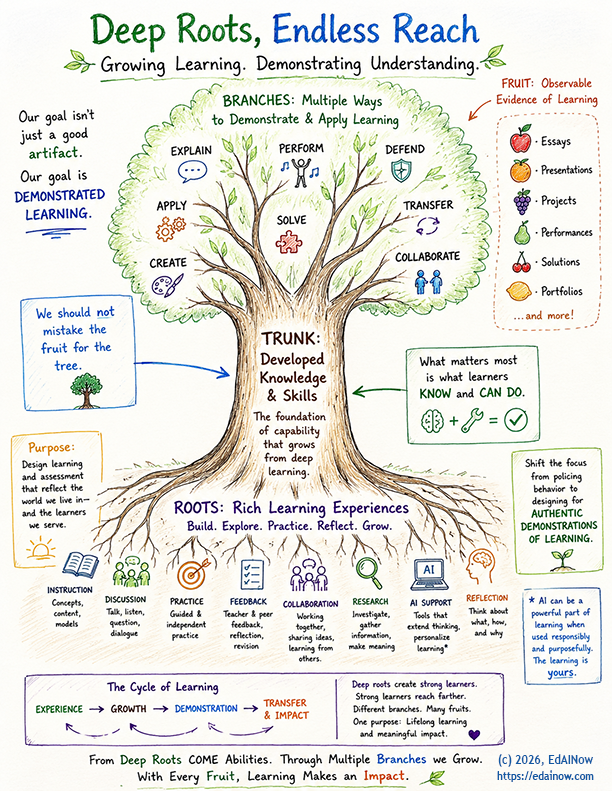
Roots: The Experiences That Build Learning
Learning begins below the surface. The roots are the experiences through which students build understanding: instruction, discussion, practice, feedback, collaboration, research, reflection, and purposeful use of AI.
Strong roots require students to think, question, practice, revise, and make meaning. They represent the learning process, not simply the completion of an assignment.
Trunk: What Students Know and Can Do
From those experiences grows the trunk: the knowledge and skills students have actually developed.
This is what ultimately matters, and this is what we want to measure and assess. Our goal is not merely to help students produce good work. It is to develop learners who can understand, reason, apply, and transfer what they have learned.
Branches: Multiple Ways to Demonstrate Learning
Students can demonstrate that learning through many branches: explaining, solving, creating, defending, performing, collaborating, applying, and transferring.
Assessment becomes stronger when students have authentic opportunities to make their thinking and capabilities visible.
Fruit: Evidence, Not the Learning Itself
Essays, presentations, projects, performances, and portfolios are the fruit. They are valuable evidence of learning, but they are not learning itself.
In an AI-accessible world, AI can increasingly produce the fruit without growing the tree.
That changes the challenge for educators: Design learning and assessment so we can see the tree behind the fruit.
Example: 9th Grade Science
Suppose students are learning about ecosystem stability and the effects of environmental change.
Roots: Build the learning.
The teacher begins with direct instruction and readings on food webs, carrying capacity, and ecosystem relationships. Students examine data from several ecosystems, discuss cause-and-effect relationships, construct models, receive feedback, and revise their thinking. AI might be used appropriately to explain an unfamiliar concept, generate questions for investigation, or provide additional practice.
Trunk: Develop knowledge and skills.
The intended learning is not simply producing a report about ecosystems. Students should be able to analyze ecological relationships, interpret evidence, predict consequences of environmental changes, and justify conclusions scientifically.
Branches: Demonstrate the learning.
Instead of relying on one finished product, the teacher asks students to demonstrate understanding in several ways. Students might:
- Interpret a new food-web diagram and explain what would happen if one species declined.
- Analyze unfamiliar population data and defend a prediction.
- Modify an ecosystem model when new conditions are introduced.
- Explain their reasoning during a brief teacher conference.
Fruit: Produce evidence of learning.
Students might ultimately create a written environmental-impact report, presentation, or infographic. AI could even assist with parts of that product if permitted.
But the polished product is only the fruit. The teacher has already gathered evidence through students’ explanations, analyses, decisions, revisions, and transfer to unfamiliar situations.
Key Question for the Teacher
The key question becomes: Can the student demonstrate the science behind the product?